

Hail damage public adjuster
Hail Damage Insurance Claims
Hail damage you can't see from the ground still costs you a roof.
Looking for a hail damage public adjuster near you in Chester, Delaware, Montgomery, Berks, Lancaster, or Lehigh County? Hail bruises shingles, cracks siding, dents gutters, and flattens AC condenser fins, damage carriers routinely call age or wear. We chalk and photograph every slope, verify the hail event at your address, and document the full loss before a number is discussed.
Call us 1st before you call your insurance, we handle it all.
The problem with hail claims
Hail damage is the easiest loss in insurance to dismiss.
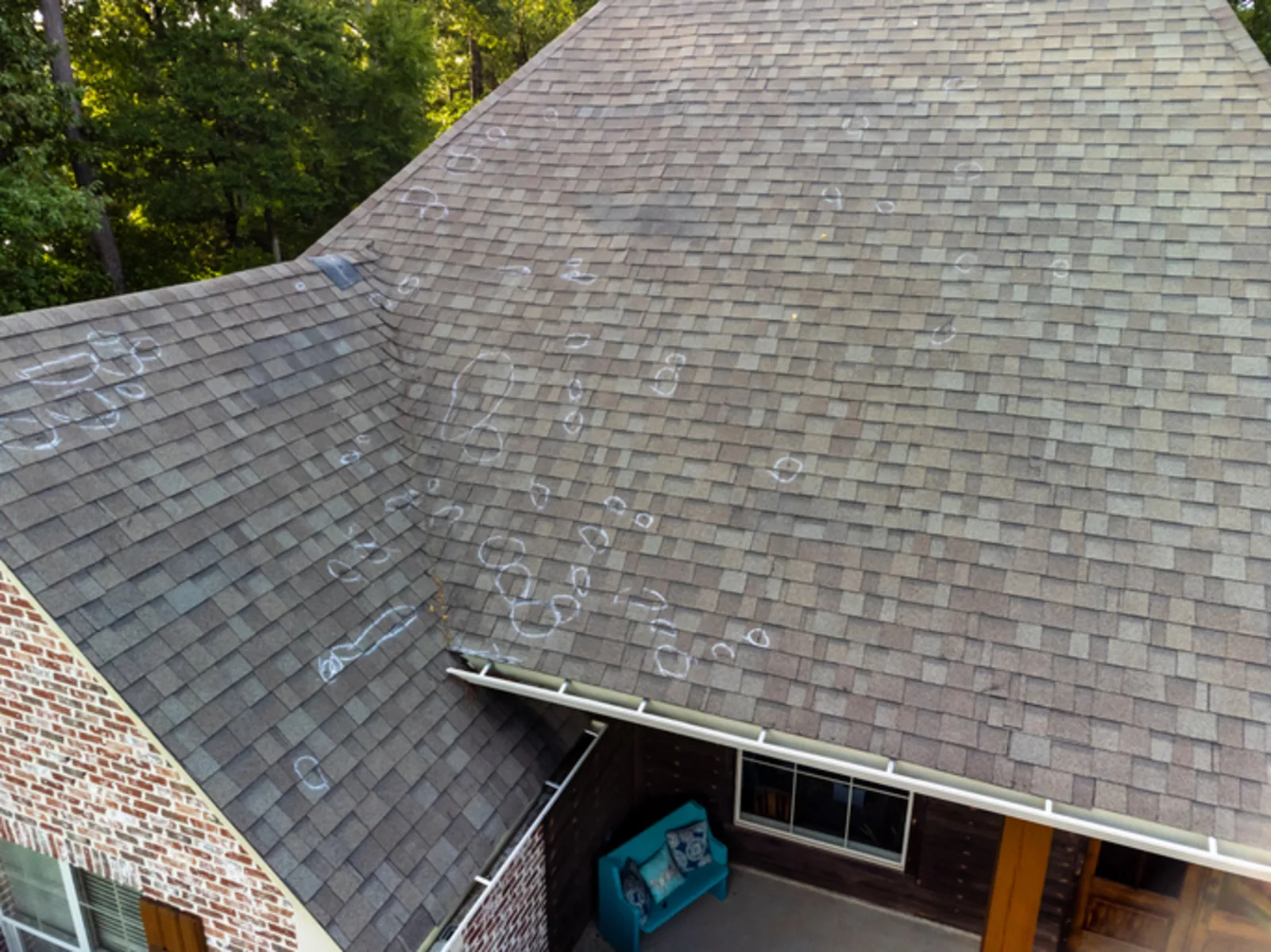
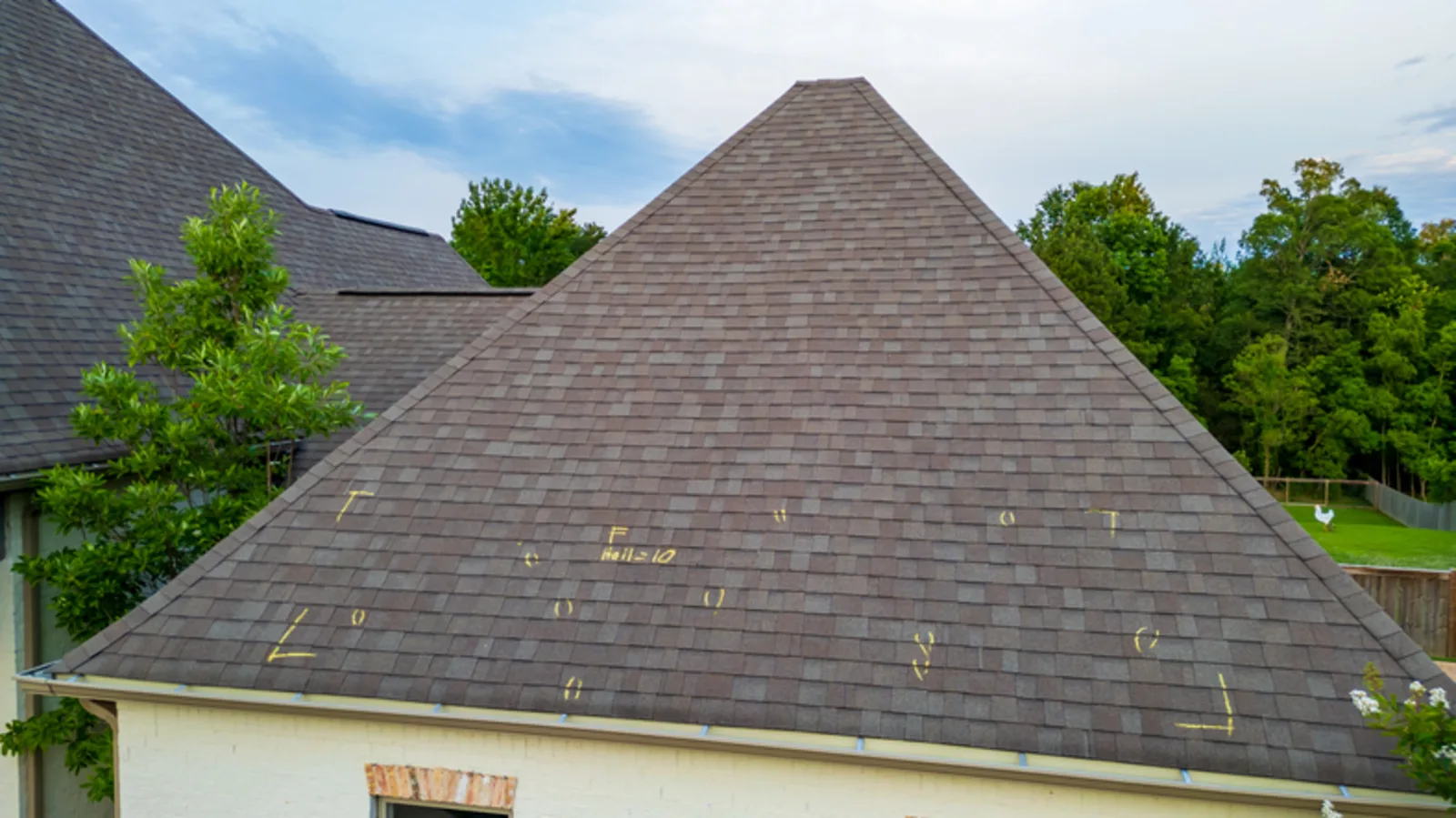
"That's just wear and tear." Hail bruising looks like granule loss, and granule loss looks like age. Without chalked test squares, close-up photography of each impact, and verified hail-size data for the date of loss, a carrier can characterize a roof full of hits as a roof at the end of its life, and pay nothing.
Partial slope payments. A common tactic is to accept hail on one or two slopes and repair only those. When hits per test square exceed threshold on multiple elevations, or the shingle is discontinued and cannot be matched, replacement of the roof system is owed. That case has to be built slope by slope.
Everything that isn't the roof. Hail hits the whole building envelope. Siding cracks and chips, window wraps and fascia dent, screens tear, skylights craze, garage doors dimple, and AC condenser fins flatten, reducing efficiency for the life of the unit. First estimates routinely include none of it.
Percentage wind and hail deductibles. With a 1%–5% hail deductible, thousands of dollars of scope can vanish into your own pocket. A complete, correctly priced scope is often what separates a claim that clears the deductible from one that never gets filed.
What we document
A complete scope of your hail loss.
Roof test squares
Chalked 10x10 test squares on every slope, with each impact marked, counted, and photographed.
Hail event verification
Reported hail size and storm path for your exact address on the date of loss.
Siding and elevations
Vinyl, aluminum, and fiber cement cracking, chipping, and holes on every exposed elevation.
Soft metals
Gutters, downspouts, wraps, vents, flashing, and garage doors, the fastest proof hail hit.
HVAC condensers
Bent and flattened condenser fins that reduce efficiency and are almost always omitted.
Detached structures
Garages, sheds, barns, decks, fencing, and metal outbuildings on the same policy.
Interior and contents
Skylight and roof leaks that appear after the storm, plus damaged personal property.
Matching and code
Discontinued shingle research, uniform appearance, and current PA code upgrades on rebuild.
Siding & exterior impact
The roof is only half of a hail claim.
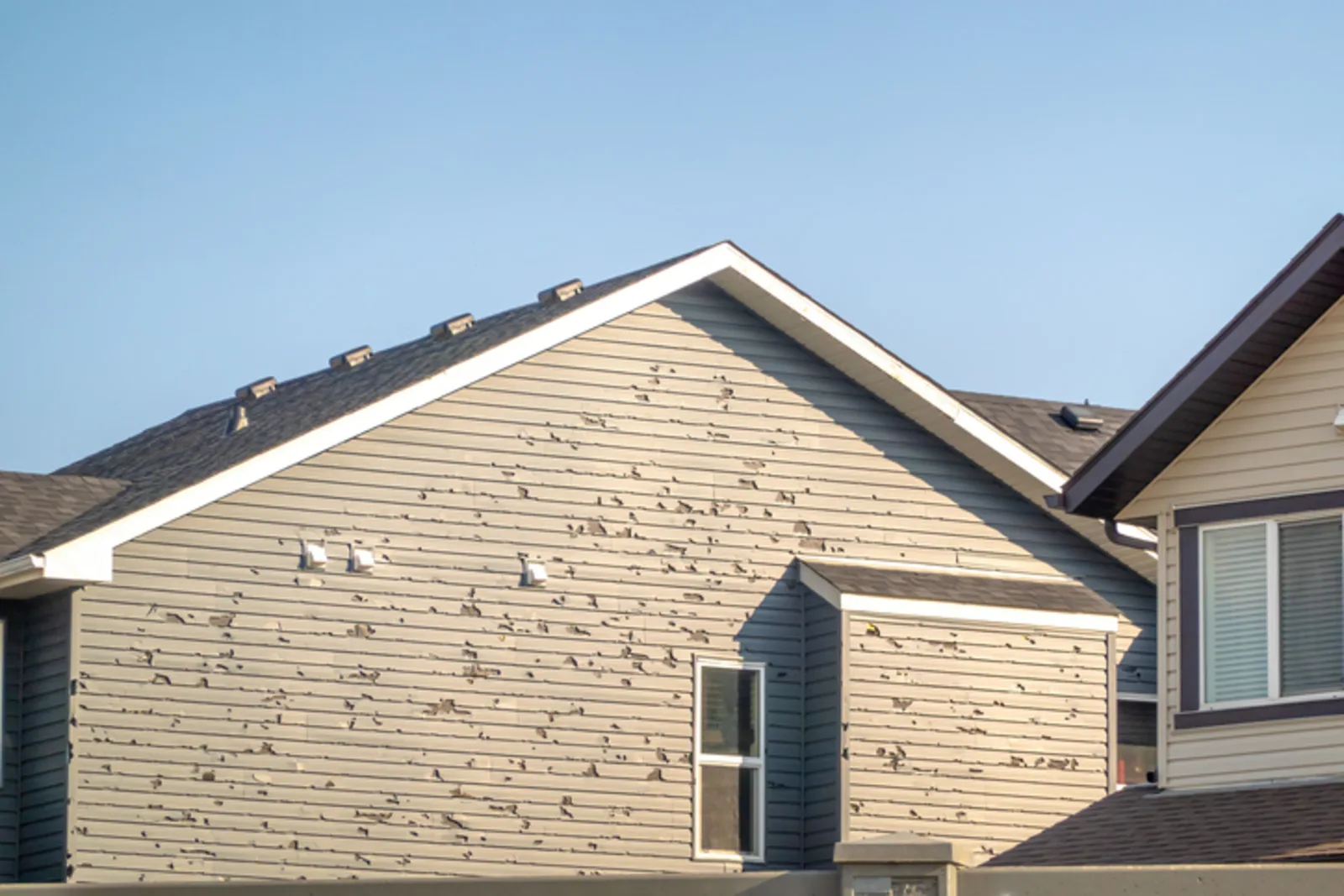
Wind-driven hail strikes walls, not just roofs. On vinyl siding it leaves cracks, chips, and punched holes concentrated on the storm-facing elevations, damage that compromises the water barrier behind the panel even when it looks cosmetic.
Matching is the real fight. Vinyl profiles and colors are discontinued constantly, and weathered panels never match new stock. When damaged panels cannot be reasonably matched, the elevation, and sometimes the wall system, is owed, not a scattering of replacement pieces.
Cosmetic exclusions. Some policies exclude purely cosmetic damage to metal roofing or siding. Whether hail damage is cosmetic or functional is a technical argument about water intrusion, coating failure, and service life, one that should be made with documentation rather than conceded on a phone call.
How it works
Four steps from hailstorm to settlement.
Step 01
Free claim review
Tell us when the hail hit. We review your policy and the damage at no cost.
Step 02
Hail inspection
Chalked test squares on every slope, elevations, soft metals, and verified hail data.
Hail documentation includes chalked test squares with hit counts per slope, elevation and soft-metal photography, reported hail size for your address, shingle and siding discontinuation research, and a line-item scope of loss.
Step 03
Submit claim and negotiate
We file and submit your claim and handle everything with the carrier.
Step 04
You get paid
Settlement issued on a fully documented claim. No recovery, no fee.
Not sure your offer is fair?
Talk to a licensed public adjuster. Free review, no obligation.
Why Legacy on a hail claim
Hail claims are decided by whoever counted the hits.
Nothing about a hail claim is settled from the driveway. We get on the roof, chalk and count impacts in test squares on every slope, verify the hail event at your address, price the full exterior and interior scope, then negotiate it. We only get paid when you do.
- Chalked test squares with documented hit counts on every slope, not a sample of one
- Reported hail size and storm path pulled for your specific address and date of loss
- Shingle and siding discontinuation research to support full replacement and matching
- Siding, soft metals, screens, skylights, garage doors, and HVAC condensers included
- Cosmetic-damage exclusions challenged on functional and service-life grounds
- Carrier reinspections and engineer reports met with our own documentation
What a hail claim actually turns on
- Hail bruising vs. granule loss from age
- One characterization decides whether the roof is paid for at all.
- Hits per test square
- Threshold counts per slope are what convert repair into replacement.
- Cosmetic vs. functional damage
- Metal roofing and siding exclusions hinge on this technical argument.
- Percentage wind and hail deductible
- A 2% hail deductible on a $400,000 home is $8,000 out of your pocket.
Licensed Pennsylvania public adjuster #726839. Contingency fee, nothing owed unless you recover.
Where we work
Hail damage public adjusters in your county.
Hail is intensely local, one storm cell can hit one township hard and skip the next. That is exactly why these claims need an in-person inspection rather than a satellite report.
Chester County
Spring and summer hail cores track along the Route 30 and Brandywine corridors, hitting West Chester, Downingtown, and Exton neighborhoods where architectural shingles and vinyl siding bruise long before they leak. We chalk and document every slope and elevation, not just the one the adjuster looked at.
Delaware County
Older twin and rowhome roofs in Upper Darby, Ridley, and Media are often on their second or third layer, and carriers reach for 'age' the moment hail is mentioned. We tie the impact pattern to a verified storm date and press the matching argument on discontinued shingles.
Montgomery County
Norristown, Lansdale, and King of Prussia see repeat hail activity, and higher-value homes here carry the exposures carriers shortcut most: metal roofing, standing-seam accents, skylights, copper gutters, and cedar or composite siding that all price differently.
Berks County
Open terrain west and north of Reading takes larger stones with fewer wind breaks. Metal barn roofing, silos, outbuildings, and HVAC condenser coils are frequently damaged and just as frequently left off the first estimate entirely.
Lancaster County
Severe-storm and hail activity across the county's farmland damages agricultural roofing, greenhouses, grain structures, and standing-seam panels that require specialty pricing rather than a residential shingle line item.
Lehigh County
Hail moving through the Lehigh Valley regularly hits whole Allentown, Emmaus, and Macungie developments at once: which makes uniform appearance, matching, and full-slope replacement the central arguments on these claims.
Google reviews
What our clients say
Real feedback from Pennsylvania homeowners and business owners who called Legacy first about a hailstorm.
Questions after a hailstorm.
Still have questions? Contact us for a free claim review.
References
Sources we used
- Insurance Information Institute, Facts and statistics: Hail
Hail is a named peril on standard homeowners policies.
- Haag Engineering, Test Square Method
Industry-standard hail inspection protocol using chalked 10×10 test squares to document impact density.
- Matthiesen, Wickert & Lehrer, Matching Regulations in All 50 States
State-by-state summary of laws and regulations governing matching of roofing and siding materials.
- Pennsylvania Insurance Department, Public Adjuster Contract
Public adjusters must use a written, department-approved contract and work on a contingency-fee basis.
Information is for general education and may not reflect your specific policy. Read your declarations page and policy form for exact coverage, limits, and exclusions.
Related claim types
Hail damage claims handled across every county we serve, see the list above.
Call us before you call your insurance company.
Where we work
Serving Chester, Montgomery, Delaware, Berks, Lancaster and Lehigh counties
See how we handle hail damage claims in your county.